
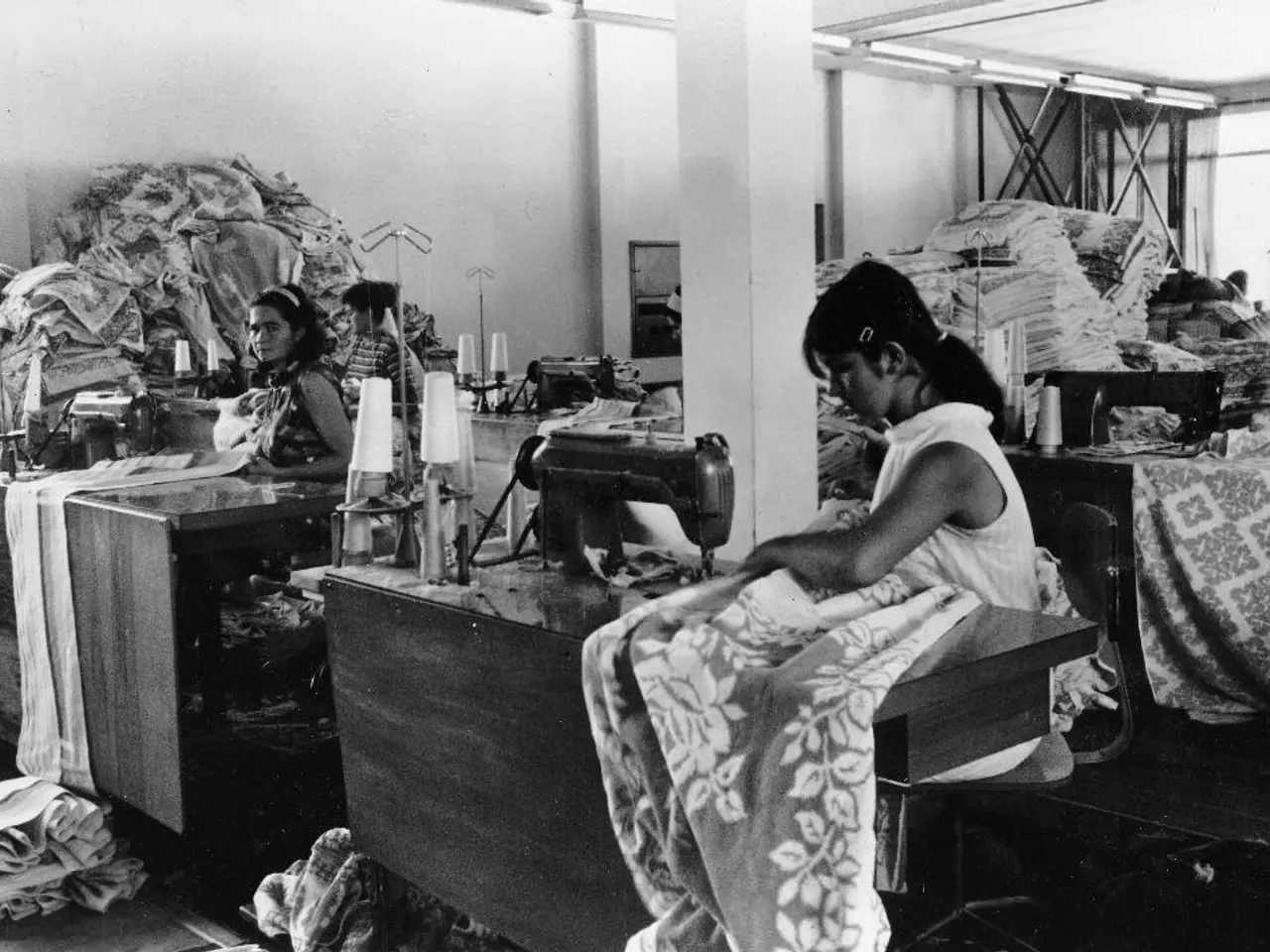
Textile industries grapple with sinking as job losses escalate
The textile and apparel industry in Istanbul, Turkey, is currently grappling with significant challenges, primarily due to declining global demand, economic difficulties, and factory closures. Over the past two years, nearly 2,960 textile businesses have shut down, resulting in the loss of 67,528 jobs in the past year alone. Since 2022, a total of 7,805 businesses have closed and 315,107 jobs have been lost, leaving a total of 382,635 workers unemployed [1].
The impact of these closures is far-reaching:
- Employment: The loss of jobs has left tens of thousands of workers struggling to make ends meet. The closure of Baltalı Group's two factories in June 2025, for example, resulted in 650 job losses [4].
- Production capacity: The shutdown of factories means a loss of production tools and machinery, weakening the industry's manufacturing base [1].
- Trade balance: The sector’s exports have dropped by 10% between 2022 and 2024 while imports increased by 55.4%, contributing $776 million to Turkey’s current account deficit in the first five months of 2025 [1].
- Shift of manufacturing abroad: Some domestic factories are relocating overseas due to economic pressures, further weakening Turkey's domestic textile industry [1].
Rafi Ay, president of the labour union Öz-İplik İş, has underscored the severity of the situation, emphasizing the need for urgent action. He has called for the preservation of production tools, factories, and machinery in the industry to prevent further damage [1].
Investment initiatives continue in related industrial sectors, such as a new $2 billion polypropylene production plant, aimed at strengthening supply chains critical for industries including textiles. This signals some momentum toward industrial resilience and job creation in linked areas [2].
Despite these efforts, the textile and apparel industry in Istanbul, Turkey, remains in a "dangerously unstable phase" [1]. With urgent calls from labor unions for support to stabilize the sector, it is clear that collective action is needed to address the challenges facing the industry.
References: [1] Anadolu Agency. (2025, June 21). Turkey's textile industry in 'dangerously unstable phase' amid factory closures, job losses. Anadolu Agency. https://www.aa.com.tr/en/economy/turkeys-textile-industry-in-dangerously-unstable-phase-amid-factory-closures-job-losses/2562623 [2] Anadolu Agency. (2025, May 25). $2 billion polypropylene plant to boost Turkey's textile industry. Anadolu Agency. https://www.aa.com.tr/en/economy/2-billion-polypropylene-plant-to-boost-turkeys-textile-industry/2557443 [3] Anadolu Agency. (2025, May 10). Turkey's textile and apparel industry contributes $776 million to current account deficit in January-May. Anadolu Agency. https://www.aa.com.tr/en/economy/turkeys-textile-and-apparel-industry-contributes-776-million-to-current-account-deficit-in-january-may/2552744 [4] Reuters. (2025, June 15). Baltalı Group closes two factories in Turkey, affecting 650 workers. Reuters. https://www.reuters.com/business/retail-consumer/baltali-group-closes-two-factories-turkey-affecting-650-workers-2025-06-15/
- Finance: The loss of 315,107 jobs since 2022 and the continued factory closures in the textile and apparel industry in Istanbul, Turkey, have significantly contributed to the country's current account deficit, totaling $776 million in the first five months of 2025 alone [1, 3].
- Industry and Finance: Urgent calls from labor unions, such as Öz-İplik İş, emphasize the need for support to stabilize the textile and apparel industry in Istanbul, Turkey, and prevent further job losses, as well as prevent the loss of assets like factories, machinery, and production tools that could help strengthen the sector's financial stability and competitive position [1].