
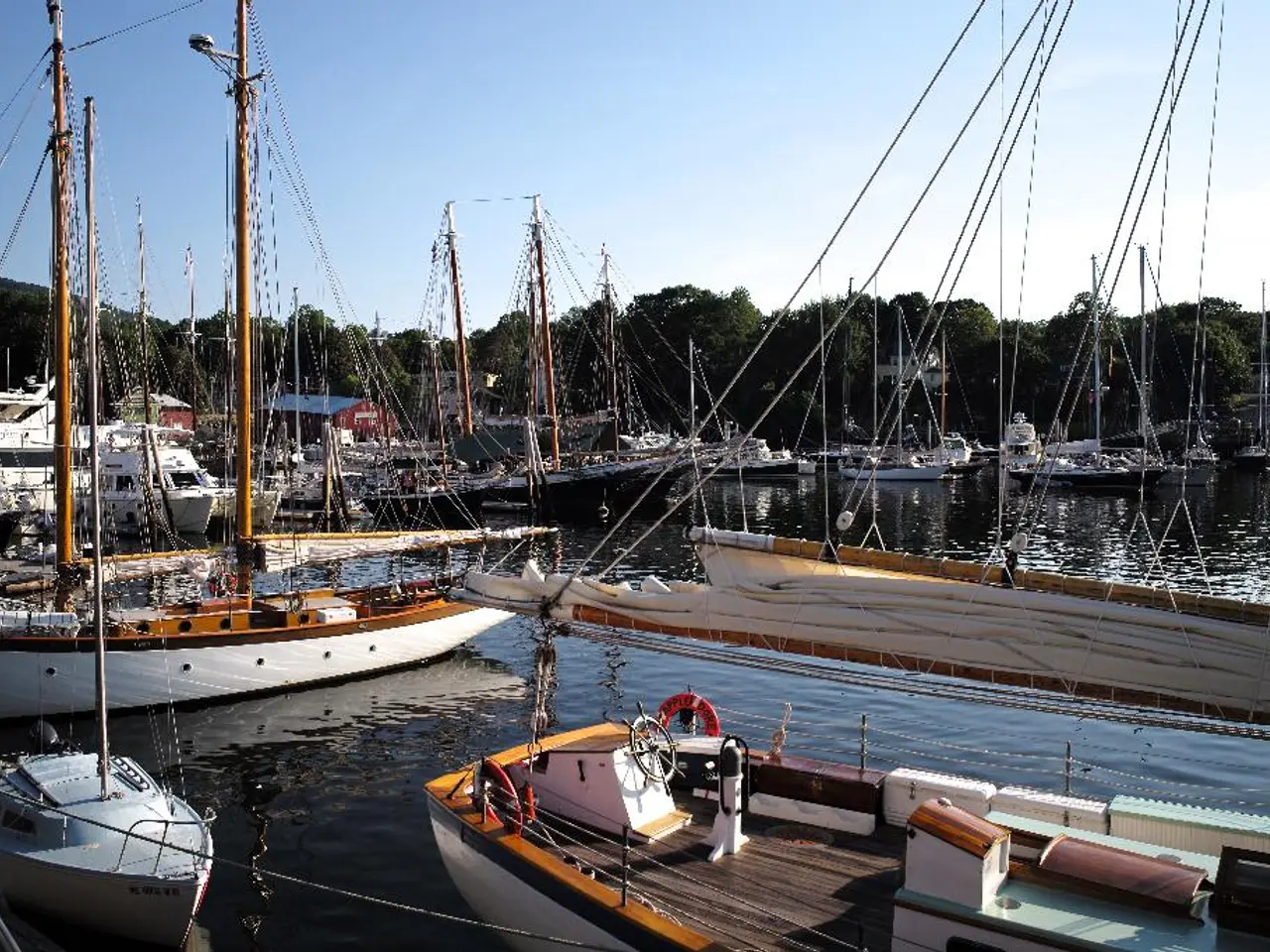
Elevated vessel traffic: 2024 projected as one of the most challenging years for the North Baltic Canal in terms of ship numbers.
The Low Vessel Transit on the North-East Sea Canal (NOK): A Persistent Trend
Once again, the canal authority in Germany faces a grim evaluation for the North-East Sea Canal (NOK). For the first time since 1945, the canal didn't see over 25,000 ship passages last year—a disappointing statistic. But there's a silver lining.
The General Directorate of Waterways and Shipping (GDWS) is taking its sweet time with the annual balance for the NOK this year. They're expected to present the figures to the public by the end of February, although they usually do so in mid-January or early February.
Jens-Broder Knudsen, chairman of the Initiative Kiel Canal, isn't mincing words. He states that ship passages decreased by up to ten percent in 2024. Shipping brokerage firms Sartori & Berger and UCA United Canal Agency support Knudsen's claim.
Speed restrictions and canal expansions: A double-edged sword
Although 2024 could go down as a tough year for the waterway, there's a glimmer of hope in sight. If the planned expansion of the canal is successful, the speed limit can be lifted, and the NOK might regain its appeal to shipowners. However, there's a catch.
Since July 1, 2023, ships on the NOK have been limited to 12 km/h due to construction work to protect the eroded slopes along the canal. Work on these damaged areas is progressing, but a three-month closure of a lock chamber in Brunsbüttel is looming again from May. Work on the lock chamber's rails for the gate bogies needs to be completed.
The response from shipowners is swift. If the closure comes to pass, they'll turn back to the route around Skagen instead.
More than a decade of declining ship passages
The shrinking number of ships on the NOK is a long-term trend that's been ongoing for over ten years. In 2014, there were still 32,600 ships. Knudsen cites shrinking midship dimensions as a significant factor. The boat pilotage fees for the around 300 canal pilots are calculated based on ship size.
"We feel this very clearly," says David-Christopher Müller, second senior of the NOKII pilotage brotherhood from Kiel. But it isn't all doom and gloom. If the canal passage becomes predictable again, the situation could change. The unpredictability is one of the reasons for declining interest in the canal, according to Müller.
"Reliability plays a crucial role in the decision for the canal," agrees Jan Klein of the shipbroker UCA United Canal Agency.
As the industry eagerly awaits the presentation of all traffic data for the NOK, it seems there may be substantial declines in cargo quantities and ship sizes, too.
Background Insights:
- The decline in the number of ship passages on the North-East Sea Canal in Germany can be attributed to growing competition from alternative routes and transport modes, changes in economic and trade patterns, environmental and regulatory factors, infrastructure constraints, and operational changes.
- The aging canal infrastructure and maintenance limitations might deter shipping companies, while temporary closures and delays can reduce the attractiveness and reliability of the canal.
- Advances in ship design, logistics optimization, and supply chain management have enabled alternative maritime routes and direct deep-sea port calls that bypass the canal.
- Increasing environmental regulations and sustainability initiatives in Europe may discourage or limit certain types of maritime traffic to reduce emissions and protect sensitive ecosystems.
[Sources]
- European transportation and traffic systems research. (n.d.); Retrieved from https://www.researchgate.net/publication/326195847_European_transportation_and_traffic_systems
- European maritime logistics trends and regulations.; (n.d.); Retrieved from https://www.euromaritime.org/euromaritime-news/maritime-trends-and-regulations-in-europe/
- The impact of environmental awareness and regulations on maritime logistics.; (2020, December 15); Retrieved from https://www.navisafe.eu/impact-of-environmental-awareness-and-regulations-on-maritime-logistics/
- Changes in trade patterns and goods demand influencing transport operations.; (2018, September 24); Retrieved from https://www.sciencedirect.com/science/article/pii/S0965856417324216
In light of the industry's growing focus on sustainable shipping practices and the European Union's environmental regulations, it's possible that a shift in finance toward greener alternatives in the transportation sector might impact the number of ships passing through the North-East Sea Canal (NOK), as shipowners may opt for routes with lower emissions or direct deep-sea port calls that bypass the canal.
Moreover, the increasing reliance on advanced logistics optimization and supply chain management could potentially minimize the need for transit through the NOK, as these factors encourage the use of alternative transportation methods and routes.




